Sever’s Disease Treatment — Cockburn Central
If your child is limping after football, netball or running, complaining of heel pain in the morning, or pulling up from sport with pain at the back of the heel, Sever’s disease is the most likely cause. It is the single most common reason children aged 8–14 visit a podiatrist — and the good news is that it responds very well to treatment.
At Cockburn Podiatry in Cockburn Central, our podiatrists are experienced in diagnosing and managing Sever’s disease in active children. Our goal is to keep your child as active as possible while allowing the growth plate to recover — and to get them back to full sport as quickly as safely possible.
What Is Sever’s Disease?
Sever’s disease — also known as calcaneal apophysitis — is inflammation of the growth plate (apophysis) at the back of the heel bone (calcaneus). Despite its name, it is not a disease; it is a painful but completely benign and self-limiting condition.
During childhood growth spurts, the heel bone grows faster than the surrounding soft tissues. The calf muscles and Achilles tendon — which attach to the heel via the growth plate — become relatively tight and pull repetitively on the still-developing growth plate. In active children, this repeated traction causes irritation and inflammation at the growth plate, producing the characteristic heel pain of Sever’s disease.
The condition resolves completely once the growth plate matures and fuses to the heel bone, typically between ages 14 and 15.
Who Gets Sever’s Disease?
Sever’s disease most commonly affects:
- Children aged 8–14 years (peak age 10–12 for girls, 12–13 for boys)
- Active children who play football, netball, basketball, athletics, soccer, or gymnastics
- Children going through a rapid growth spurt
- Children who have recently increased their training load or started a new sport season
- Children with flat feet or tight calf muscles, which increase the load on the Achilles tendon and heel
Symptoms of Sever’s Disease
- Heel pain during or after physical activity — particularly running, jumping, and change of direction
- Pain and stiffness at the back and sides of the heel, first thing in the morning
- Tenderness when the sides of the heel are squeezed (positive ‘squeeze test’)
- Limping during sport or after activity
- Walking on tiptoes to avoid pressing on the painful heel
- Symptoms in one or both heels (bilateral Sever’s disease is common)
- Pain that improves with rest but returns with activity
What Causes Sever’s Disease?
- Rapid growth — the calcaneal growth plate is most vulnerable during growth spurts when bone grows faster than muscle and tendon
- Tight calf muscles — limited flexibility increases Achilles tendon tension on the growth plate
- High activity load — sudden increases in training, a new sport season, or competing in multiple sports
- Hard training surfaces — repeated impact on hard ground amplifies stress through the heel
- Poor footwear — worn-out or unsupportive sports shoes that provide inadequate heel cushioning
- Biomechanical factors — flat feet or overpronation increase the load through the Achilles and heel
Sever’s Disease Treatment at Cockburn Podiatry
Our podiatrists conduct a thorough assessment that includes evaluation of your child’s foot mechanics, Achilles flexibility, footwear, and training load. Treatment is tailored to your child’s age, sport, symptom severity, and goals. Our options include:
Load Management & Activity Modification
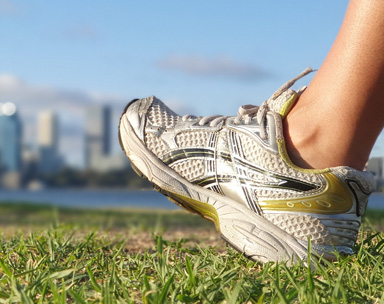 Managing the activity load is the cornerstone of Sever’s disease treatment. Complete rest is rarely necessary and is often counterproductive — instead, we work with children and parents to identify which activities provoke symptoms and provide clear, practical guidance on modifying training to reduce pain while maintaining as much sporting participation as possible.
Heel Raises
Simple heel raise inserts placed inside your child’s shoes reduce the tension the Achilles tendon places on the growth plate by slightly elevating the heel. They are one of the fastest ways to reduce symptoms and are used from the very first appointment. We advise using them in both school shoes and sports shoes.
Stretching & Strengthening Program
A targeted home program of calf stretching and lower limb strengthening is fundamental to Sever’s disease recovery. Stretching the calf muscle complex (both gastrocnemius and soleus) directly reduces the tension pulling on the growth plate. Strengthening the foot and lower leg muscles improves overall load tolerance. Our podiatrists provide clear, illustrated programs appropriate for your child’s age and ability.
Strapping & Taping
Supportive strapping of the heel and ankle can provide immediate pain relief by reducing the stress on the growth plate during activity. It is particularly useful during the acute phase of treatment, allowing your child to participate in essential sport or physical education while the growth plate settles.
Custom Orthotics
Where flat feet, overpronation, or other biomechanical factors are contributing to Sever’s disease, custom foot orthotics are prescribed following a detailed biomechanical assessment. They correct abnormal foot mechanics, reduce the rotational stress through the Achilles tendon, and incorporate built-in heel cushioning to further offload the growth plate. Health fund rebates are available. Learn more about custom orthotics →
Footwear Assessment & Advice
The wrong footwear can significantly worsen Sever’s disease. We assess all of your child’s current shoes — including school shoes, sport shoes, and casual footwear — and make specific recommendations for supportive, well-cushioned options with an appropriate heel counter. Worn-out sports shoes should be replaced, as the shock-absorbing properties degrade well before the upper wears out.
Will My Child Need to Stop Playing Sport?
Complete rest is rarely the answer for Sever’s disease. With the right podiatry management, most children can continue participating in their sport — often with only minor modifications to their training load. The goal is always to keep your child as active as safely possible. Where symptoms are severe and rest is advised, we make sure it is for the shortest period necessary and provide a clear return-to-sport plan.
Why Choose Cockburn Podiatry for Sever’s Disease?
- Experienced podiatrists with a specific interest in paediatric podiatry and children’s sports injuries
- Child-friendly clinic environment — our team is skilled at putting children at ease
- Custom orthotics available in-clinic — no referral to another provider needed
- Clear return-to-sport planning — we work with your child’s coaches and school where needed
- BUPA and Medibank preferred providers — maximum health fund rebates
- Medicare CDM and DVA card holders welcome
- Conveniently located at Cockburn Central, serving South Lake, Yangebup, Atwell, Success, Hammond Park and surrounds
Frequently Asked Questions
How do I know if my child has Sever’s disease?
The classic presentation is an active child aged 8–14 who complains of heel pain during or after sport, with morning stiffness and tenderness at the back and sides of the heel when squeezed. They may limp or walk on their toes. A podiatry assessment will confirm the diagnosis and rule out other causes.
How long does Sever’s disease last?
With appropriate treatment, most children see significant improvement within 2–6 weeks and return to full sport within 2–4 months. The condition resolves completely when the growth plate fuses — typically by age 14–15. Without treatment, Sever’s disease can persist for months and significantly limit sporting participation.
Can Sever’s disease come back?
Yes — it can recur, particularly during further growth spurts or when training load increases suddenly. Good calf flexibility, supportive footwear with heel cushioning, and sensible training load management reduce the risk of recurrence.
Is Sever’s disease serious?
No. Despite the name, Sever’s disease is a completely benign condition and causes no permanent damage. It is a normal response to the stress of growth and physical activity on a developing heel bone. With treatment, children recover fully and have no long-term problems.
Do I need a referral?
No referral is needed to see us at Cockburn Podiatry. Simply book online or call (08) 9417 3737. Medicare CDM rebates are available with a GP referral, and all major health funds are accepted via on-the-spot HICAPS.
Serving south Perth: We treat patients from Atwell, Success, South Lake, Yangebup, Hammond Park, Aubin Grove, Jandakot, Beeliar, Coogee, Baldivis and the wider Cockburn area.
Ready to get your child back to sport? Call us on (08) 9417 3737 or book online. No referral needed. Serving Cockburn Central, South Lake, Yangebup, Atwell, Success, Aubin Grove, Hammond Park, Jandakot and surrounds.
Related services: Children’s Podiatry | Custom Orthotics | Sports Podiatry