Corns & Calluses Treatment — Cockburn Central
Corns and calluses are among the most common reasons people visit a podiatrist — and one of the most satisfying conditions to treat, because the relief after professional debridement is immediate. At Cockburn Podiatry in Cockburn Central, our podiatrists don’t just remove the hard skin; we identify and address the underlying cause so you stay pain-free for longer.
What Are Corns and Calluses?
Corns and calluses are areas of thickened, hardened skin (hyperkeratosis) that develop as a protective response to repeated pressure or friction on the foot.
- Calluses are diffuse areas of thickened skin, most commonly found on the heels, balls of the feet, and the big toe. They are generally not sharply painful but can become uncomfortable and cracked if left untreated.
- Corns are smaller, more focused lesions with a hard, compacted central nucleus (core) that presses into the underlying tissue like a thorn. They cause a sharp, deep, or stabbing pain when walked on or when direct pressure is applied. There are several types:
- Hard corns (heloma durum) — on the tops and tips of toes, and over bony prominences
- Soft corns (heloma molle) — between the toes, kept soft by moisture; can be particularly painful
- Seed corns — tiny, superficial corns on the sole, often in clusters
Symptoms
- Thick, rough, or hardened skin on the sole, heel, toes, or between toes
- A sharp, stabbing, or burning pain when walking or pressing on the area (corns)
- Aching, tenderness, or discomfort in the ball or heel of the foot (calluses)
- Dry, flaky, or waxy appearance of the skin
- In severe calluses, cracking or fissuring of the skin (particularly at the heels)
- Swelling or redness around a corn
What Causes Corns and Calluses?
- Ill-fitting footwear — shoes that are too tight, too loose, or too narrow create friction and pressure hotspots
- Foot deformities — bunions, hammertoes, flat feet, and high arches create abnormal pressure points
- Abnormal biomechanics — the way you walk (gait) determines where pressure concentrates on your sole
- Occupations — prolonged standing or walking on hard surfaces
- Age — the fat pads under the foot thin with age, reducing natural cushioning
- Going barefoot on hard surfaces
- Wearing shoes without socks
Corns & Calluses Treatment at Cockburn Podiatry
Professional Debridement
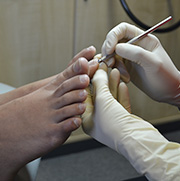 Our podiatrists use specialist scalpels to safely and painlessly remove callus and corn tissue. Unlike home treatments or pedicure salons, podiatry debridement removes the entire corn nucleus, providing immediate and complete pain relief. The procedure is typically painless — the skin being removed is non-living tissue — and takes only minutes. For diabetic patients and those with peripheral vascular disease, professional debridement is essential: home cutting or salicylic acid products carry serious infection risk.
Padding & Offloading
Following debridement, we apply protective padding (felt, foam, or silicone) to redistribute pressure away from the treated site. This gives the area time to heal and significantly reduces the rate at which the hard skin returns. We teach patients how to apply and replace padding between appointments where appropriate.
Custom Orthotics
Where corns and calluses are driven by abnormal biomechanics — such as excess pressure under the ball of the foot, or an uneven gait pattern — custom orthotics redistribute load across the foot more evenly. This is the most effective long-term solution for recurring calluses and is particularly useful for patients with flat feet, high arches, or significant deformities. Learn more about custom orthotics →
Footwear Assessment & Advice
Footwear is the most common cause of corns and calluses. We assess all of your current shoes and identify which are contributing to the problem. Specific recommendations for footwear with appropriate width, depth, and cushioning can reduce the recurrence rate dramatically.
Moisture Therapy & Skin Care Advice
For patients with significant callus build-up — particularly on the heels — we recommend and prescribe specific high-strength urea creams that soften thickened skin and reduce callus accumulation between appointments. We provide clear guidance on how and when to apply them.
A Note for Patients with Diabetes
Calluses and corns carry a higher risk for people with diabetes. Callus build-up under the foot increases pressure on the underlying tissue and significantly raises the risk of diabetic foot ulceration. Regular podiatry debridement, combined with footwear and orthotic management, is an essential part of diabetic foot care. We recommend 6-weekly or more frequent appointments for diabetic patients with active callus. Learn more about diabetic foot care at Cockburn Podiatry →
Why Choose Cockburn Podiatry?
- Experienced podiatrists providing safe, painless, and immediately effective debridement
- We address the underlying cause — not just the symptom
- BUPA and Medibank preferred providers — maximum health fund rebates
- Medicare CDM and DVA card holders welcome
- Conveniently located at Cockburn Central, serving South Lake, Yangebup, Atwell, Success, Hammond Park and surrounds
Frequently Asked Questions
What is the difference between a corn and a callus?
A callus is a broad area of thickened skin, while a corn has a hard central core (nucleus) that presses inward into the tissue, causing sharper, deeper pain. Both are caused by pressure and friction but require slightly different treatment approaches.
Will corns come back after treatment?
If only the hard skin is removed without addressing the underlying cause, corns and calluses will return. Our podiatrists identify and treat the root cause through padding, footwear changes, and orthotics — significantly reducing the frequency of recurrence.
Is it safe to cut corns at home?
We strongly advise against cutting corns at home, particularly for people with diabetes, poor circulation, or reduced sensation. The risk of infection or damage to healthy skin is significant. Over-the-counter corn plasters (salicylic acid) should also be avoided by diabetic patients. Professional podiatry debridement is safe, painless, and immediately effective.
Are corns the same as plantar warts?
No — they are different conditions requiring different treatment. Warts are caused by a virus (HPV) and have a different appearance and pain pattern. A podiatrist can accurately diagnose which condition you have and prescribe appropriate treatment.
Do I need a referral?
No referral is needed. Simply book online or call (08) 9417 3737. All major health funds accepted via on-the-spot HICAPS.
Serving south Perth: We treat patients from Atwell, Success, South Lake, Yangebup, Hammond Park, Aubin Grove, Jandakot, Beeliar, Coogee, Baldivis and the wider Cockburn area.
Get immediate relief from corn and callus pain. Call us on (08) 9417 3737 or book online. No referral needed.
Related services: Medical Pedicure | Diabetic Foot Care | Custom Orthotics