
Foot Neuroma (Morton’s Neuroma) Treatment — Cockburn Central
A burning, shooting pain in the ball of your foot — often radiating into your toes — is one of the hallmark symptoms of a Morton’s neuroma. If you feel like you’re constantly stepping on a pebble or a bunched-up sock, you may be dealing with this common but very treatable condition.
At Cockburn Podiatry in Cockburn Central, our experienced podiatrists assess and treat Morton’s neuromas using a range of evidence-based conservative treatments. Most patients achieve excellent results without injections or surgery.
What Is a Morton’s Neuroma?
A Morton’s neuroma is a thickening of the tissue surrounding the digital nerve that runs between the metatarsal bones in the ball of the foot. It most commonly develops between the third and fourth toes, though it can occur between the second and third toes as well.
Despite the name, it is not a tumour — it is a benign fibrous thickening of the nerve sheath caused by chronic irritation and compression of the nerve. The nerve becomes enlarged and inflamed, producing the characteristic pain and neurological symptoms.
Related conditions we also assess and manage include:
- Metatarsalgia — generalised pain and inflammation in the ball of the foot
- Plantar plate tears — injury to the ligament supporting the toe joints
- Bursitis of the forefoot — inflammation of fluid-filled sacs between the metatarsal heads
- Stress fractures of the metatarsal bones
Symptoms of a Foot Neuroma
- A sharp, burning, or shooting pain in the ball of the foot
- Pain that radiates into the third and fourth toes (or second and third toes)
- A sensation of standing on a pebble or bunched-up sock
- Tingling or numbness in the affected toes
- Pain that worsens in narrow or high-heeled shoes and improves when barefoot or in wide shoes
- Pain during or after prolonged standing, walking, or running
- A clicking sensation between the toes when walking (Mulder’s click)
Common Causes & Risk Factors
- Footwear — tight, narrow, or pointed-toe shoes that compress the toes together are the leading cause
- High heels — heels above 5 cm increase forefoot pressure significantly
- High-impact activities — running, aerobics, and court sports that repeatedly stress the forefoot
- Foot structure — flat feet, high arches, bunions, and hammertoes alter load distribution and increase nerve irritation
- Occupations — jobs requiring prolonged standing or crouching on hard surfaces
- Previous foot injury or surgery near the forefoot
Foot Neuroma Treatment at Cockburn Podiatry
Our podiatrists conduct a thorough clinical assessment — including a Mulder’s click test and biomechanical examination — to confirm the diagnosis and identify contributing mechanical factors. Where imaging is needed to rule out other causes, we can refer for ultrasound. Our treatment options include:
Metatarsal Padding & Domes
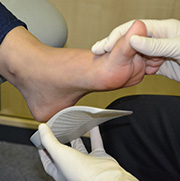 Metatarsal padding is one of the most effective first-line treatments for Morton’s neuroma. A small dome-shaped pad is placed just behind the ball of the foot to splay the metatarsal bones apart, directly reducing compression on the affected nerve. Properly positioned padding can provide rapid pain relief and is often used in the initial stages of treatment.
Custom Orthotics
Custom-made prescription orthotics address the underlying biomechanical factors that load the forefoot and compress the nerve. They redistribute pressure away from the neuroma and can incorporate metatarsal supports for ongoing nerve offloading. Orthotics are fabricated from a scan of your foot following a comprehensive biomechanical assessment. Learn more about custom orthotics at Cockburn Podiatry →
Footwear Assessment & Advice
Footwear is the primary driver of Morton’s neuroma in most patients. Our podiatrists assess your current shoes and provide specific recommendations for footwear with a wide toe box, adequate forefoot cushioning, and a lower heel. Switching footwear alone — particularly away from narrow or high-heeled shoes — can produce a dramatic improvement in symptoms.
Activity Modification
Reducing the activities that provoke symptoms — particularly high-impact exercise in tight footwear — gives the irritated nerve time to settle. We provide practical guidance on how to modify your activity load without complete rest, so you can maintain fitness while the nerve recovers.
Low Level Laser Therapy (LLLT)
Low level laser therapy reduces inflammation and promotes tissue healing at a cellular level. It is used as an adjunct to mechanical treatments to reduce pain and accelerate recovery, particularly in cases where nerve inflammation is significant.
Injection Therapy & Specialist Referral
Where conservative measures have not provided sufficient relief, we can refer for ultrasound-guided corticosteroid injection, which targets inflammation around the nerve directly and can provide substantial, lasting relief. In resistant cases, we refer to a podiatric surgeon for specialist review. Surgery (neurectomy — removal of the thickened nerve segment) is considered only when all conservative options have been thoroughly trialled.
Why Choose Cockburn Podiatry for Neuroma Treatment?
- Experienced podiatrists with expertise in forefoot pain and biomechanical assessment
- Comprehensive clinical assessment — accurate diagnosis before any treatment is started
- Custom orthotics and laser therapy available in-clinic — no referral to another provider
- BUPA and Medibank preferred providers — maximum health fund rebates
- Medicare CDM and DVA card holders welcome
- Conveniently located at Cockburn Central, serving South Lake, Yangebup, Atwell, Success, Hammond Park and surrounds
Frequently Asked Questions
What does a Morton’s neuroma feel like?
A Morton’s neuroma typically produces a sharp, burning, or shooting pain in the ball of the foot, often radiating into the third and fourth toes. Many patients describe the sensation of standing on a pebble or a bunched-up sock. Tingling and numbness are also common. Symptoms usually worsen in narrow footwear and improve when barefoot or in wide shoes.
Can a neuroma go away on its own?
Mild neuromas can improve significantly with footwear changes and activity modification alone. However, without addressing the underlying mechanical cause, symptoms often recur. Early podiatry intervention gives the best chance of long-term resolution without injections or surgery.
Will I need an injection or surgery for a neuroma?
The majority of Morton’s neuromas respond well to conservative podiatry treatment and do not require injections or surgery. Where conservative care has not provided sufficient relief, we can refer for ultrasound-guided corticosteroid injection. Surgery is reserved for cases where all conservative options have been exhausted.
Do I need a referral?
No referral is needed to see us at Cockburn Podiatry. Simply book online or call (08) 9417 3737. Medicare CDM rebates are available with a GP referral, and all major health funds are accepted via on-the-spot HICAPS.
What shoes should I wear if I have a Morton’s neuroma?
Look for footwear with a wide, roomy toe box, adequate forefoot cushioning, and a heel no higher than 2–3 cm. Avoid pointed-toe shoes and any footwear that squeezes the toes together. Our podiatrists can recommend specific brands and styles suited to your foot type.
Serving south Perth: We treat patients from Atwell, Success, South Lake, Yangebup, Hammond Park, Aubin Grove, Jandakot, Beeliar, Coogee, Baldivis and the wider Cockburn area.
Ready to get rid of your forefoot pain? Call us on (08) 9417 3737 or book online. No referral needed. Serving Cockburn Central, South Lake, Yangebup, Atwell, Success, Aubin Grove, Hammond Park, Jandakot and surrounds.
Related services: Custom Orthotics | Sports Podiatry | Plantar Fasciitis Treatment