
Bunion (Hallux Valgus) Treatment — Cockburn Central
A bunion is one of the most common foot deformities, yet many people put off seeking treatment until the pain becomes severe. The sooner a bunion is assessed and managed, the better the long-term outcome. At Cockburn Podiatry in Cockburn Central, our podiatrists provide expert conservative bunion management to relieve pain, slow progression, and keep you active — and refer for surgical review when conservative care is no longer sufficient.
What Is a Bunion?
A bunion — medically known as hallux valgus — is a progressive deformity of the big toe joint (first metatarsophalangeal joint) in which the big toe angles toward the second toe. This causes the head of the first metatarsal bone to protrude outward, creating the characteristic bony bump on the inner side of the foot at the base of the big toe.
As the deformity progresses, secondary changes develop: the joint capsule and surrounding soft tissues become stretched and inflamed, bursa (fluid-filled sacs) can form over the prominence, and the big toe may push under or over the second toe. Osteoarthritis of the big toe joint is a common long-term consequence.
Related conditions we also assess and manage include:
- Bunionette (Tailor’s bunion) — a similar deformity affecting the little toe joint
- Hallux limitus/rigidus — stiffness or arthritis of the big toe joint
- Hammertoes — often develop secondary to bunion deformity
Symptoms of a Bunion
- A visible bony bump at the base of the big toe on the inner side of the foot
- Redness, swelling, and tenderness over the bony prominence
- Pain at the big toe joint, particularly with walking or wearing shoes
- The big toe pointing toward or crossing over the second toe
- Restricted movement and stiffness of the big toe joint
- Corns or calluses where the toes rub against each other or against shoes
- Difficulty finding comfortable footwear
- In advanced cases, persistent joint pain even at rest
What Causes Bunions?
- Genetics — a strong hereditary predisposition. If your parents had bunions, you are at significant risk
- Foot structure — flat feet, hypermobility (loose joints), and a long first metatarsal all predispose to bunion formation
- Footwear — narrow, pointed-toe shoes and high heels accelerate progression in those who are predisposed
- Joint disease — rheumatoid arthritis and gout can cause or worsen bunion deformity
- Sex — bunions are significantly more common in women, largely due to footwear patterns
Bunion Treatment at Cockburn Podiatry
It is important to understand that conservative podiatry treatment cannot reverse a bunion — once the bone has deviated, only surgery can realign it. However, conservative management is highly effective at slowing or stopping progression, relieving pain, and maintaining function. Many patients manage bunion symptoms successfully for years without needing surgery. Our treatment options include:
Custom Orthotics
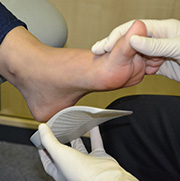 Custom foot orthotics are one of the most effective tools for slowing bunion progression. By correcting abnormal foot mechanics — particularly overpronation and hypermobility — orthotics reduce the abnormal forces that push the big toe out of alignment. They are fabricated from a scan of your foot following a biomechanical assessment and are prescribed to address your specific deformity pattern. Learn more about custom orthotics →
Padding & Deflection Devices
Gel pads and bunion shields placed over the prominence reduce friction and pressure from footwear, providing significant pain relief. Interdigital wedges between the big and second toe help maintain toe alignment and prevent the toes from crossing. These simple devices can make a dramatic difference to day-to-day comfort.
Toe Spacers & Splints
Silicone toe spacers hold the big toe in a more corrected position and reduce joint stress. Night splints can slow deformity progression and maintain range of motion. While splints cannot permanently correct a bunion, they are useful adjuncts in mild to moderate cases.
Footwear Assessment & Advice
Footwear selection is critical. Shoes with a wide, deep toe box eliminate the compressive forces that worsen bunion pain and accelerate deformity. We assess all of your current footwear and make specific brand and style recommendations. We also advise on when existing shoes need to be replaced and how to identify well-fitting footwear independently.
Joint Mobilisation & Exercise
Maintaining the range of motion of the big toe joint slows the development of arthritis and maintains walking function. We prescribe targeted toe and foot exercises and, where appropriate, use manual therapy techniques to maintain joint mobility.
Referral for Surgical Review
When conservative management is no longer providing adequate pain relief, or when the deformity is significantly limiting daily life, we refer to a podiatric or orthopaedic surgeon for specialist review. Surgical correction (osteotomy) realigns the bones and can be very effective for appropriate candidates. We maintain a network of trusted surgical specialists and will discuss the most appropriate referral pathway for your situation.
Why Choose Cockburn Podiatry for Bunion Management?
- Experienced podiatrists with expertise in forefoot biomechanics and progressive deformities
- Custom orthotics fabricated in-clinic — no referral elsewhere
- BUPA and Medibank preferred providers — maximum health fund rebates
- Medicare CDM and DVA card holders welcome
- Trusted surgical referral network when conservative care has been exhausted
- Conveniently located at Cockburn Central, serving South Lake, Yangebup, Atwell, Success, Hammond Park and surrounds
Frequently Asked Questions
Can a bunion be fixed without surgery?
Conservative podiatry cannot reverse a bunion, but it is very effective at slowing progression, relieving pain, and maintaining function. Many patients manage comfortably for years without surgery. Surgery is considered when pain is severe and significantly limits daily life despite conservative care.
What makes bunions worse?
Narrow, pointed-toe footwear and high heels are the main aggravating factors — they compress the toes and push the big toe further inward. Flat feet, hypermobility, and prolonged standing also accelerate progression.
Will my bunion get worse over time?
Bunions are progressive — without intervention, they typically worsen. The rate of progression varies greatly. Footwear changes, orthotics, and joint offloading can significantly slow progression and maintain comfort for many years.
Are bunions hereditary?
Yes — there is a strong hereditary component. However, footwear choices and biomechanical factors strongly influence whether and how quickly a hereditary bunion develops.
Do I need a referral?
No referral is needed to see us at Cockburn Podiatry. Simply book online or call (08) 9417 3737.
Serving south Perth: We treat patients from Atwell, Success, South Lake, Yangebup, Hammond Park, Aubin Grove, Jandakot, Beeliar, Coogee, Baldivis and the wider Cockburn area.
Ready to manage your bunion pain? Call us on (08) 9417 3737 or book online. No referral needed.
Related services: Custom Orthotics | Foot Neuromas | Plantar Fasciitis